- Home
- Case Studies
- Vastu Case Study No. 02
Case Study No. 02 · Industrial Vastu
In-Vitro Diagnostic Kit Manufacturing Unit — Comprehensive Vastu Shastra & Bio-Energy Assessment
Property Snapshot
| Property type | In-vitro diagnostic (IVD) kit manufacturing unit — first-floor production layout: rapid-kit packing, cassette assembly and pouching, ELISA reagent dispensing, membrane lamination and coating, cold storage, change rooms and support areas |
|---|---|
| Assessment method | Classical Vastu Shastra analysis + Bio-Energy Scan (Lecher Antenna) |
| Scope of study | Full-floor directional audit on a 16-zone Brahmasthan-centred grid, 32-gate entrance analysis, and an 81-pada Vastu Purusha Mandala reading |
| Site orientation | True north falls to the left of the drawing sheet, verified against the surveyed north mark |
| Structural changes required | None — corrected without demolition or civil work |
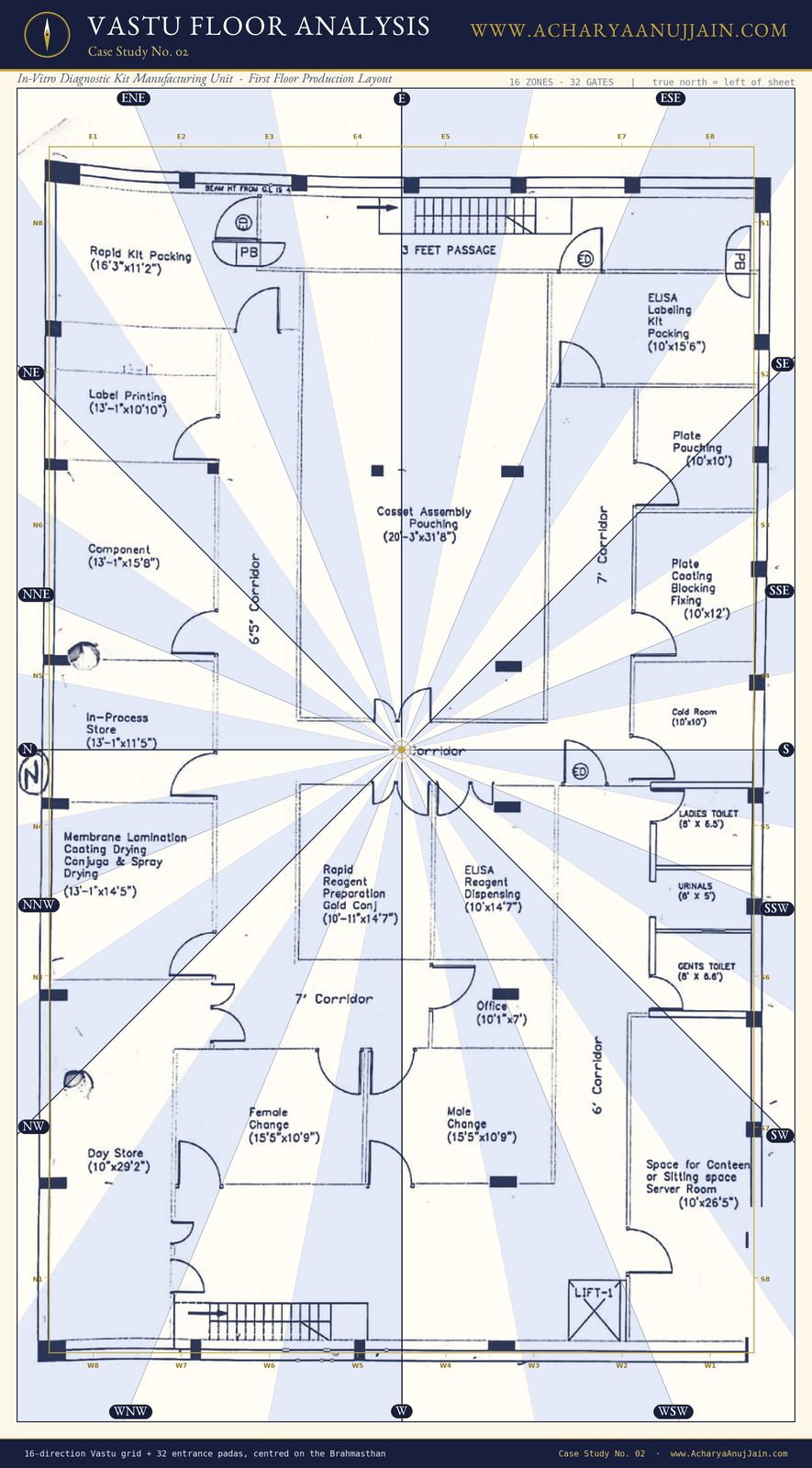
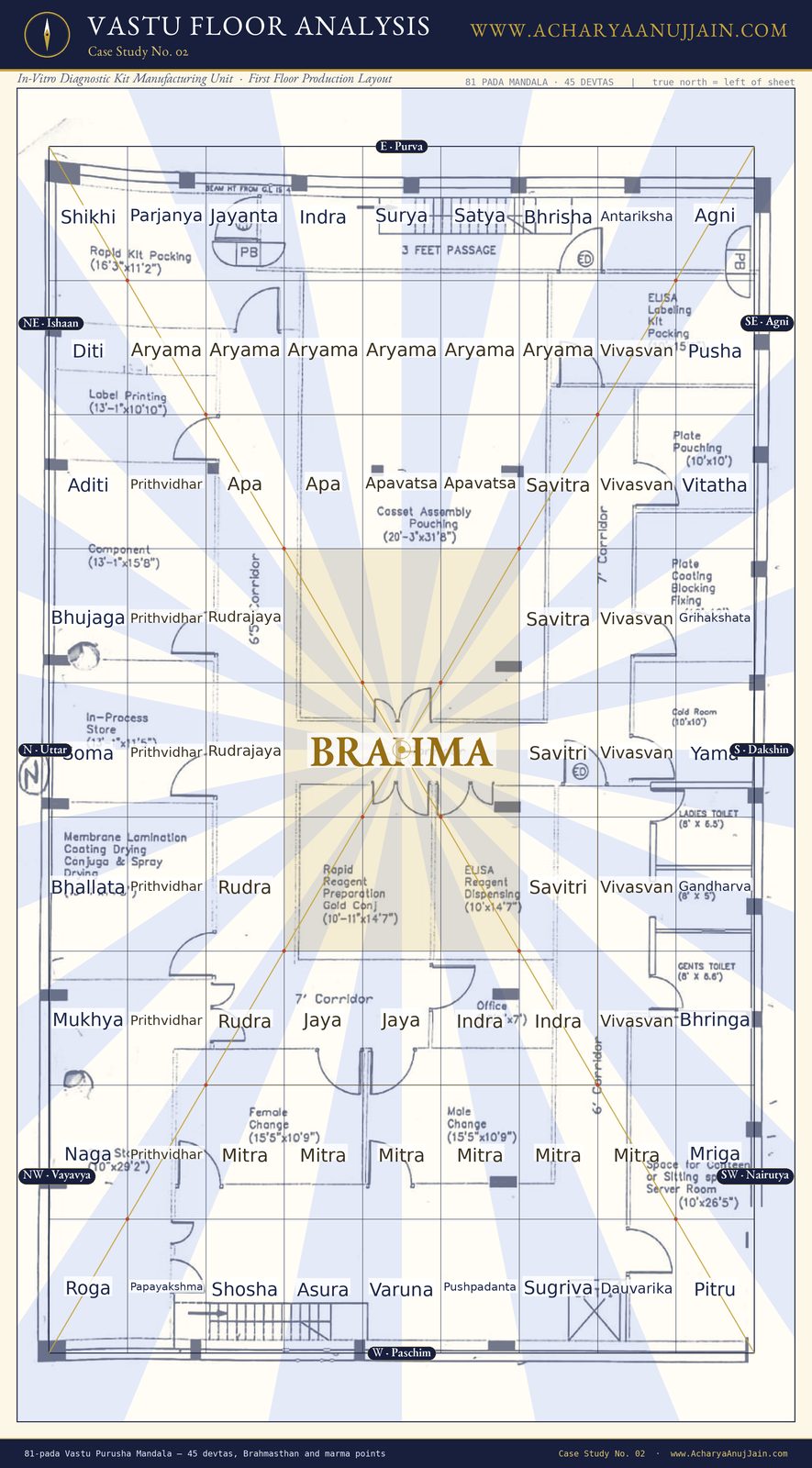
See the accompanying 16-Zone Vastu Analysis Map and 81-Pada Vastu Purusha Mandala for the visual reference to this report.
Presenting Concerns
The unit came to IHAS as a working production floor that simply would not breathe. It was closed on every side but one — the main door — with the eastern flank the only elevation genuinely open to air and daylight. The management had already done everything a good engineer would do: air conditioning, exhaust systems, and treatment to the beam and column grid overhead. The floor was mechanically ventilated and technically compliant, and it still felt cramped, heavy and suffocating to the people working in it.
That gap is the reason the consultation was commissioned. In Vastu practice a space can be mechanically ventilated and still be energetically sealed — the two are not the same thing. Alongside the physical stagnation, the promoters reported the pattern that usually accompanies it in a manufacturing environment: work that did not flow cleanly from one stage to the next, effort that seemed to leak away between departments, and a general absence of momentum on the floor.
The constraint was unusually tight. This is a regulated manufacturing environment, where process flow, cleanroom adjacency and validation requirements meant that walls, services and the main entrance could not be moved. Every correction had to be achieved within the existing shell.
Methodology
The assessment combined two layers of analysis:
- Directional Vastu analysis — the corrected floor plan was overlaid on a 16-zone radial grid centred on the Brahmasthan, mapping every process room, utility, service and entry point to its precise zone. Because the main entrance could not be relocated, a 32-gate (entrance pada) analysis was run around the periphery to establish exactly which gate the entry occupied and what could be done about it. An 81-pada Vastu Purusha Mandala was then laid over the floor to read the devta and marma positions beneath the heavy beam and column grid.
- Bio-energy scan — a Lecher Antenna survey was taken across the floor to measure earth energy, cosmic energy, cosmotelluric energy and the ratio of positive to negative energy, and to check for geopathic stress (disturbed earth-grid energy, commonly linked to underground water veins, fault lines or mineral deposits).
Bio-Energy Scan Readings
| Reading | Result (pre-correction) | Interpretation |
|---|---|---|
| Cosmic Energy | 10% | Severely depleted |
| Earth Energy | 20% | Well below the healthy range |
| Cosmotelluric Energy | 30% | Weak earth–cosmic coupling |
| Positive Energy | 30% | Sharply under-balanced |
| Negative Energy | 70% | Dominant |
| Geopathic Stress | Present | Disturbed earth-grid energy detected |
| Structural stressor | Excess beams and columns | Dominant physical suppressor across the floor |
A healthy working space typically shows earth and cosmic energy in the 50–60% range, with positive energy well above negative. Here the ratio was inverted, but the reading that stands out is cosmic energy at 10%.
Cosmic energy enters a structure principally through the North-East and through the building's openings. On this floor the North-East was sealed, and the envelope was closed on every side but one. There was, quite literally, almost no path for it to enter. The 10% figure was not an abstract number — it was a direct measurement of the condition the staff were describing as suffocation.
Major Doshas Identified
The survey recorded a number of secondary observations across other zones; the five below were the most significant and are presented here as the primary findings.
1. A Sealed North-East (Ishaan), with an Electrical Panel in the ENE
The North-East is governed by the water element and is the entry point for cosmic energy into any structure. It is the zone of clarity, health and fresh direction. On this floor it was fully closed — no opening, no light, no air.
Compounding it, the electrical panel sat in the East-North-East, immediately adjoining Ishaan. Placing concentrated fire and electromagnetic load against the water zone is one of the more disruptive combinations in commercial Vastu: the element that should be feeding the space its cleanest energy is instead being scorched at its own doorstep.
Classical effect: Stagnation and mental fog across the workforce, health complaints without clear cause, blocked decision-making, and an inability to bring new work or new thinking into the business. In a manufacturing context it typically shows up as processes that never quite stabilise.
2. Main Entrance in the West-North-West (WNW)
The main entrance is the mouth of the structure — the single largest determinant of what energy enters and in what quality. This unit's only entrance falls in the WNW, and it could not be moved: the entry is fixed by the building core, the stair and lift access, and the regulated process flow inside.
Classical effect: An entrance in this band tends to bring instability in support functions and in the movement of goods and money — commitments that shift, supply and dispatch that never settle into rhythm, and a business that works hard for every unit of return.
3. An Obstructed, Non-Circulating Brahmasthan
The Brahmasthan is the energetic core of a structure and should remain open, light and unobstructed — it is the point from which every zone draws. Here the centre of the floor was occupied by reagent preparation and dispensing activity, and circulation through it from the main directions was blocked.
Classical effect: When the centre is loaded and cannot circulate, energy does not distribute to the zones — it pools and stalls. This is the specific Vastu signature behind the "work does not flow" complaint: not a failure in any one department, but a failure of the whole floor to move as one system.
4. Excess Beams and Columns Across the Production Floor
The floor carried an unusually dense grid of beams and columns. In Vastu, a beam directly overhead exerts downward pressure on whatever sits beneath it, and a column interrupts the flow of energy across a space. At the density recorded here, the cumulative effect was significant enough to register as a primary finding rather than a secondary observation, and it correlated directly with the depressed earth and cosmotelluric readings.
Classical effect: Persistent heaviness and fatigue for anyone working beneath the grid, reduced concentration, and a physical sensation of compression that people describe as the room feeling smaller than it is.
5. Toilets in the South-West (Nairutya)
The South-West is the earth-element zone of stability, weight, leadership and retention — in a business, the zone that holds the promoters, the heavy assets and the accumulated gains. A toilet placed here puts a drainage and disposal function directly over the zone meant to hold and consolidate.
Classical effect: Difficulty retaining what the business earns, instability at the level of ownership and senior management, and decisions that lack weight or do not hold.
Zone-Wise Placement Reference
Mapped from the corrected floor plan against the 16-direction Brahmasthan grid, as surveyed before correction.
| Zone | Bearing | Rooms / Elements Present |
|---|---|---|
| N (Uttar) | 0° | In-Process Store |
| NNE | 22.5° | Component Store |
| NE (Ishaan) | 45° | Label Printing, corridor — zone fully sealed, no opening — dosha zone |
| ENE | 67.5° | Rapid Kit Packing, electrical panel — dosha zone |
| E (Purva) | 90° | Cassette Assembly Pouching, 3-ft passage — the one genuinely open flank |
| ESE | 112.5° | ELISA Labelling and Kit Packing |
| SE (Agni) | 135° | Plate Pouching, 7-ft corridor |
| SSE | 157.5° | Plate Coating / Blocking / Fixing |
| S (Dakshin) | 180° | Cold Room |
| SSW | 202.5° | Service corridor |
| SW (Nairutya) | 225° | Toilets (Ladies / Urinals / Gents), canteen and sitting space — dosha zone |
| WSW | 247.5° | Server room, corridor |
| W (Paschim) | 270° | Male Change, Female Change, Office |
| WNW | 292.5° | Main entrance — dosha zone |
| NW (Vayavya) | 315° | Day Store |
| NNW | 337.5° | Membrane Lamination, Coating Drying, Conjugate and Spray Drying |
| Brahmasthan (Centre) | — | Rapid Reagent Preparation (Gold Conjugate), ELISA Reagent Dispensing — obstructed |
Corrective Measures Prescribed
All corrections below were completed without any demolition, civil work or structural alteration — an absolute requirement on a validated manufacturing floor.
- Main Gate (Entrance) Correction — the WNW entrance could not be relocated, so the Vastu main-entrance correction technique was applied: an energetic and directional correction at the gate itself, re-qualifying the energy entering through it without touching the physical opening.
- Ishaan Activation — a mandir and dedicated open space were created in the North-East, opening the zone and restoring the primary cosmic-energy path into the floor. This single measure did more for the cosmic reading than any other.
- Electrical Panel Relocation — the panel was moved out of the ENE and into the East / East-South-East, clearing fire and electromagnetic load away from Ishaan and placing it in a zone that carries it appropriately.
- Opening the Brahmasthan — the centre was cleared and circulation re-established through it from the main directions, allowing the floor to distribute energy outward to every zone instead of pooling at the core.
- Toilet Relocation — toilets were moved from the South-West to the South-South-West, clearing the Nairutya stability zone and placing the disposal function in the sub-zone that is meant to carry it.
- Training Room in the WSW — a training room was created in the West-South-West, the zone of depth, learning and retained knowledge. Placing the unit's skill-building function in its natural zone converts what is often dead storage space into an active asset.
- Cross-Ventilation System in the North-West — a proper cross-air and ventilation system was established in the NW, the air-element zone, so that movement was created in the zone that governs it rather than fought against everywhere else.
- Five-Element (Panchtatva) Realignment of All Unit Activities — every activity on the floor was reviewed against Fire, Earth, Air, Water and Space and realigned to its correct zone. This is the backbone of the correction and is set out in full in the next section.
- Chain-of-Work Re-Sequencing — the production sequence was re-established as a proper directional chain so that material and effort move with the floor's energy rather than across it, preventing the energy loss between stages that the promoters had reported.
- Beam and Column Treatment — targeted treatment of the overhead grid to lift the downward pressure on the workstations beneath it.
- Therapies Applied — Crystal Therapy; Geopathic Rods for the detected geopathic stress; Element Balancers; Metallurgy; 16 Directional Enhancers; and Pyramids and yantras in stone and metal, placed zone by zone.
Establishing an Industrial Unit by the Five Elements and Sixteen Directions
This case is a useful template, because the question behind it applies to any manufacturing facility: where does each activity belong? A factory is not laid out by preference — it is laid out by element. Get the elemental zoning right and the corrections needed later are minimal.
The five elements and their zones in a manufacturing unit
| Element | Zone | What belongs here | What to keep out |
|---|---|---|---|
| Fire — Agni | South-East | Boiler, ovens, drying and heat processes, electrical room, DG set, transformer, canteen kitchen | Water storage, raw-material stores, cash and records |
| Earth — Prithvi | South-West | Heaviest machinery, raw material and finished-goods storage, promoter and senior management cabins, records | Toilets, pantry, large openings, underground tanks, staircases to a basement |
| Air — Vayu | North-West | Dispatch and loading, finished-goods movement, marketing and HR, ventilation plant, change rooms | Heavy immovable storage, fire processes, anything that must stay still |
| Water — Jal | North-East | Water source and storage, open space, mandir, R&D and planning, cleanroom entry lobby | Toilets, electrical panels, heavy machinery, stores, clutter of any kind |
| Space — Akash | Brahmasthan (centre) | Open circulation, natural light, cross-air — and nothing else | Machinery, columns, toilets, stores, staircases, partitions |
The eight sub-directions, read for industry
The 16-zone grid is where a factory audit earns its keep, because the sub-directions are far more specific than the four quadrants:
- NNE — health and cleanliness of the workforce. Keep clear and unobstructed.
- ENE — refreshment and recreation. Break areas belong here. Never an electrical load.
- ESE — analysis and scrutiny. Quality control, testing and the analytical lab.
- SSE — energy and confidence. Power distribution and high-energy processes.
- SSW — disposal. Waste, scrap, effluent and toilets — everything the unit needs to let go of.
- WSW — depth, learning and retention. Training rooms, technical documentation, R&D archives.
- WNW — support and replenishment. Consumable stores, banking and dispatch support.
- NNW — attraction and sales. Sales, marketing and finished goods awaiting despatch.
The correction in this case study followed exactly this logic. The training room went to the WSW not because there was room for it there, but because that is the zone that holds learning. The ventilation went to the NW because that is the zone of air. The electrical panel left the ENE because refreshment and fire do not share a zone.
Result
After relocation and correction — with no demolition and no civil work — the floor was re-scanned with the Lecher Antenna. The readings had returned to the healthy band: cosmic and earth energy lifted out of the depleted range, the positive-to-negative ratio reversed, and the geopathic stress neutralised. The physical shell had not changed at all. What changed was where each activity sat within it, what entered through the gate, and whether the centre could breathe.
Frequently asked questions
Where should the main gate of a factory be as per Vastu?
What happens if the North-East (Ishaan) of a factory or office is closed?
Can an electrical panel be placed in the North-East as per Vastu?
Why must the Brahmasthan of an industrial unit be kept open?
Do beams and columns cause Vastu dosha?
Where should toilets be placed in a factory as per Vastu?
Which direction is best for a training room in a factory?
What is cosmotelluric energy, and how is it measured?
Can Vastu defects in a running factory be corrected without demolition?
This case study reflects a professional Vastu Shastra assessment conducted by Acharya Anuj Jain (IHAS). Vastu Shastra is a traditional science; individual experiences and outcomes may vary. This content is for informational purposes and does not constitute medical, financial or legal advice.
Considering an assessment of your own space?
Send the floor plan and we will go through it together. Every consultation is set out in full on the Services page, including plainly what it cannot do.