- Home
- Case Studies
- Residential Apartment
From the records
From the Records
I have kept notes on every consultation since I started. These are drawn from them, anonymised, and published with permission. Each one follows the same four steps: what the situation was, what I observed, what we changed, and what followed.
I have not included outcomes I cannot stand behind, and you will not find a case here that ends in a doubled turnover. That is not what this work does.
Case Study No. 01 · Residential Vastu
Residential Apartment — Vastu Shastra & Bio-Energy Assessment
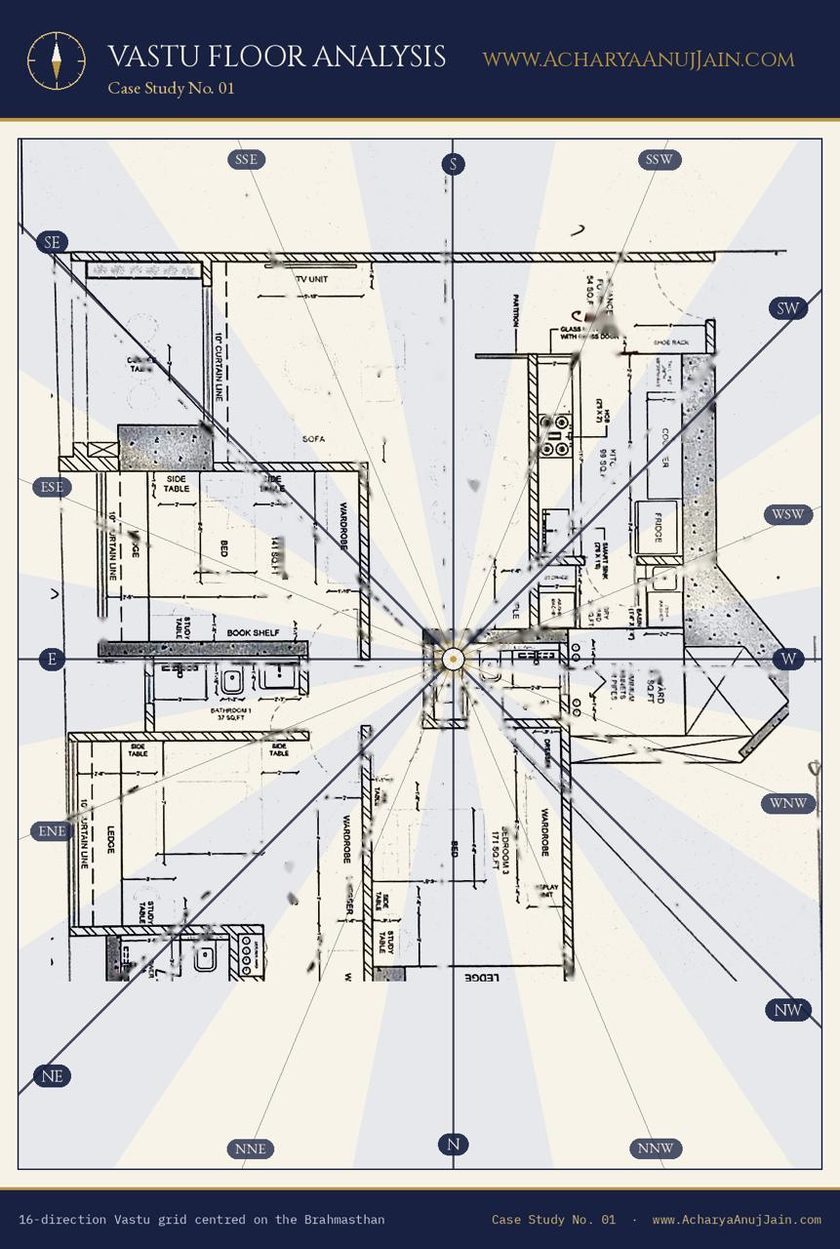
Property Snapshot
| Property type | Residential apartment, 3 bedrooms + living/dining + kitchen + utility |
|---|---|
| Assessment method | KP Vastu Shastra analysis + Bio-Energy Scan (Lecher Antenna) |
| Scope of study | Full-unit directional audit, 16-zone Brahmasthan-centred grid |
| Structural changes required | None |
Presenting Concerns
The family approached IHAS with a cluster of recurring, unrelated-seeming issues that had persisted despite no obvious external cause — a general loss of peace and recurring health complaints, expenditure consistently outpacing income, and ongoing friction within the household. This pattern — problems across health, finance, and relationships simultaneously — is a classic signature in Vastu practice of multiple, compounding doshas rather than a single fixable issue, which is exactly what the site survey confirmed.
Methodology
- Directional (KP Vastu) analysis — the floor plan was overlaid on a 16-zone radial grid centred on the Brahmasthan (the geometric and energetic centre of the plot), mapping every room, fixture, and entry point to its precise zone.
- Bio-energy scan — a Lecher Antenna reading was taken across the site to measure the balance of earth energy, cosmic energy, and the ratio of positive to negative energy, and to check for geopathic stress (disturbed earth-grid energy, commonly linked to underground water veins, fault lines, or mineral deposits).
Bio-Energy Scan Readings
| Reading | Result | Interpretation |
|---|---|---|
| Earth Energy | Below the healthy range | |
| Cosmic Energy | Below the healthy range | |
| Positive Energy | Significantly under-balanced | |
| Negative Energy | Sharply elevated | |
| Geopathic Stress | Present | Disturbed earth-grid energy detected |
A healthy living space typically shows earth and cosmic energy in the 50–60% range and positive energy well above negative. Here, the negative-to-positive ratio was inverted — a strong indicator that the directional doshas below were not isolated design issues but were actively suppressing the energetic health of the whole home.
Major Doshas Identified
The survey surfaced a number of secondary observations across other zones as well; the four below were the most significant and are presented here as the primary findings.
1. Toilet in the Northeast (Ishaan)
The Northeast is governed by the water element and is considered the most sensitive zone in the home — associated with clarity, mental peace, and health. A toilet (a drainage and waste zone) placed here directly conflicts with Ishaan's function.
Classical effect: Loss of peace of mind, recurring and hard-to-diagnose health issues, disturbed sleep, and a general sense of heaviness in the home.
2. Toilet in the Brahmasthan (Centre)
The Brahmasthan is the energetic core of the home — it should ideally remain open, light, and unobstructed. A toilet located at the centre is considered one of the more serious doshas in Vastu, as it places waste and drainage function directly over the point the entire structure's energy radiates from.
Classical effect: The home's central support is compromised — this typically shows up as instability across multiple life areas at once (health, finances, relationships) rather than one specific problem, since every zone draws from this centre.
3. Main Gate in the South-South-West (SSW)
SSW falls within the South-West quadrant, governed by the earth element and traditionally associated with stability, savings, and the head of household — but the specific SSW sub-zone is regarded as a loss/disposal-oriented zone. An entrance here channels the home's primary energy inflow through an unfavourable direction.
Classical effect: Expenditure consistently exceeding income, accumulating debt, and difficulty retaining wealth despite steady effort or earnings.
4. Kitchen in the South-West (SW)
The kitchen (fire element) is ideally placed in the South-East (Agni) zone. Locating it in the South-West — the zone of stability, relationships, and the senior-most family members — puts fire energy directly where calm, grounded energy is needed most.
Classical effect: Increased friction, ego clashes, and instability in family relationships, disproportionate to any single identifiable cause.
Zone-Wise Room Placement Reference
Mapped directly from the corrected floor plan against the 16-direction Brahmasthan grid.
| Zone | Bearing | Rooms / Elements Present |
|---|---|---|
| N (Uttar) | 0° | Bedroom 3, curtain-line boundary |
| NNE | 22.5° | Bedroom 2, study table, wardrobe |
| NE (Ishaan) | 45° | Bathroom 2 (toilet) — dosha zone |
| ENE | 67.5° | Ledge, Bedroom 2 boundary |
| E (Purva) | 90° | Bedroom 1, side table, Bathroom 1 |
| ESE | 112.5° | Bedroom 1, wardrobe |
| SE (Agni) | 135° | Coffee table, TV unit corner |
| SSE | 157.5° | Sofa, TV unit |
| S (Dakshin) | 180° | Living/dining boundary, TV unit wall |
| SSW | 202.5° | Main entrance, entrance foyer — dosha zone |
| SW (Nairutya) | 225° | Kitchen, counter — dosha zone |
| WSW | 247.5° | Kitchen, fridge, counter |
| W (Paschim) | 270° | AC yard, fridge |
| WNW | 292.5° | Dresser, wardrobe (Bedroom 3), display unit |
| NW (Vayavya) | 315° | Wardrobe, display unit |
| NNW | 337.5° | Ledge, curtain-line boundary |
| Brahmasthan (Centre) | — | Toilet / wash fixture, pooja unit — dosha zone |
Corrective Measures Prescribed
All corrections below were completed without any demolition, civil work, or structural alteration — a key requirement for the family, given the property was already fitted out.
- Five-Element (Panchtatva) Balancing — realigning the Earth, Water, Fire, Air, and Space elements across the affected zones using traditional correction methods appropriate to each dosha.
- Main Gate Correction — energetic and directional correction of the entrance to neutralise the SSW loss-zone effect, without relocating the physical gate.
- Crystal Therapy — targeted placement of specific crystals to rebalance the Northeast and Brahmasthan zones.
- Yantra Therapy — installation of zone-specific yantras to counteract the toilet-in-Ishaan and toilet-in-Brahmasthan doshas.
- Pyramid Therapy — grid placement of vastu pyramids to correct geopathic stress and lift the earth/cosmic energy readings.
- Individual Astrological Remedial Measures — a separate KP astrological reading was prepared for each family member, identifying their personal favourable/unfavourable directions and elements, so daily routines could be aligned to the individual alongside the structural corrections.
Frequently Asked Questions
What happens if there is a toilet in the Northeast (Ishaan) zone as per Vastu?
The Northeast governs clarity, peace of mind, and health, and its ruling element is water. A toilet in this zone is considered one of the more common and disruptive doshas, typically associated with loss of peace, disturbed sleep, and recurring health issues that don't trace to an obvious cause.
Is a toilet in the Brahmasthan (centre of the house) bad in Vastu?
Yes — it is regarded as one of the most serious placements in Vastu Shastra. The Brahmasthan should remain open and unobstructed, as it is the point the whole home's energy radiates from. A toilet here can affect multiple areas of life simultaneously rather than causing one isolated problem.
What does a main entrance in the South-West direction mean in Vastu?
It depends on the exact sub-zone. An entrance in the SSW sub-zone in particular is associated with a loss/disposal orientation, often linked to expenses outpacing income and difficulty retaining savings, even when earnings are healthy.
Can a kitchen in the South-West zone cause relationship problems?
In classical Vastu, the kitchen's fire element is ideally placed in the South-East. A South-West kitchen places fire energy in the zone meant for stability and family relationships, which is traditionally linked to increased friction and instability among family members.
What is geopathic stress, and how is it measured in a Vastu consultation?
Geopathic stress refers to disturbed earth-grid energy, often linked to underground water veins, fault lines, or mineral deposits beneath a site. It's measured using tools like the Lecher Antenna, which reads the balance of earth energy, cosmic energy, and the positive-to-negative energy ratio at a location.
Can Vastu doshas be corrected without structural or civil changes?
Yes, in many cases. Non-structural remedies — element balancing, crystal and yantra therapy, pyramid grids, and directional corrections — can meaningfully rebalance a space's energy without demolition or renovation, particularly where structural change isn't practical.
What is Lecher Antenna therapy used for in Vastu assessment?
It's a bio-energy measurement tool used to quantify a site's earth energy, cosmic energy, and positive/negative energy balance, and to detect geopathic stress — giving a numerical baseline before corrections and a way to measure improvement afterward.
This case study reflects a professional Vastu Shastra assessment conducted by Acharya Anuj Jain (IHAS). Vastu Shastra is a traditional science; individual experiences and outcomes may vary. This content is for informational purposes and does not constitute medical, financial, or legal advice.
Currently
Cases in preparation
Cases are published here one at a time, and only once written permission from the client is on file. That is slower than filling the page would be, and it is the reason anything you eventually read here can be relied on.
If you would like to see how the work is actually done before any of these are up, the two places that show it best are the process on the Services page and the free self-assessments — both are drawn from the same records.
The standard
How every case here is written
The same four headings, in the same order, every time — so you can compare one against another rather than take each on its own terms.
The four-part structure
Property type · City or region · Year
The situation
What the client came with, in their words — and the constraint they were working inside. Rented, no budget, cannot close the shop, an elderly parent who cannot use stairs. Constraints are what make a case worth reading.
What I observed
The specific things I saw, with directions and locations named. The zone, the direction, the placement. Where I was surprised by something, it says so.
What we changed
The actual changes, with a cost band against each — nothing, under ₹5,000, a weekend’s work. Including anything I recommended that the client declined, and why.
What followed
What was reported to me, attributed as such. Never a financial figure, never a guarantee. Where only part of it worked, or nothing much changed, that is what it says.
Rules I hold myself to here
What you will not find on this page
No client identified without written permission
No name, company, logo or photograph appears without permission on file first. Cases are anonymised so that a local reader could not work out who the client was.
No financial outcome claims
Not “turnover rose”, not “sales improved”, not “business doubled”. Those claims are unprovable, and I would rather you judged the work on what can be described.
No guarantees, stated or implied
No “this always works” and no “in every such case”. Each building and each chart is its own situation.
At least one case that did not fully work
A page of unbroken triumphs reads as marketing. When these go up, one of them will be a partial result — because that is what makes the others believable.
If you would rather not judge it on your own
Bring the floor plan or the birth details and we will go through it together. Every consultation is set out in full on the Services page.